
Ocean Data Platform Academy
Education program for students, professionals and ocean leaders
designed to build the practical data skills needed to work with ocean data.
500+
of real ocean, climate
and biodiversity datasets
130+
students and professionals
in the first pilots
30+
lectures across 3 modules covering data management
Who is it for?
ODP Academy teaches the fundamentals of working with ocean data. Its self-paced modules can be adapted to different subjects and teams. Universities can include the first two modules in their curricula for free. Tailored training is also available for research projects and businesses, typically through funded programmes or partnerships.
Students
Build data skills employers and research groups look for, using the same types of data and tools used across ocean science, industry and policy.
Universities and educators
Bring real-world ocean data into your teaching. We work with you to fit ODP Academy into your course.
Professionals and leaders
Bring ocean data into your daily work: find relevant datasets, combine sources and turn them into evidence for decisions.
Piloted at the University of Bergen
In autumn 2026, 80 students in BIO213 Marine Ecology, Environment and Resources
are using the ODP over 14 weeks in hands-on assignments with real ocean datasets.
As part of their learning, students are awarded an ODP Academy certificate of completion.
“Ocean data is becoming increasingly more accessible.
It is important that students learn to use real data and become motivated to explore the world with them.
ODP Academy is an excellent entry point for students that fit nicely into our teaching plan. The entire cohort in the Marine Ecology course is now certified with their course in downloading and analyzing ocean data.”
ODP Academy Close Up
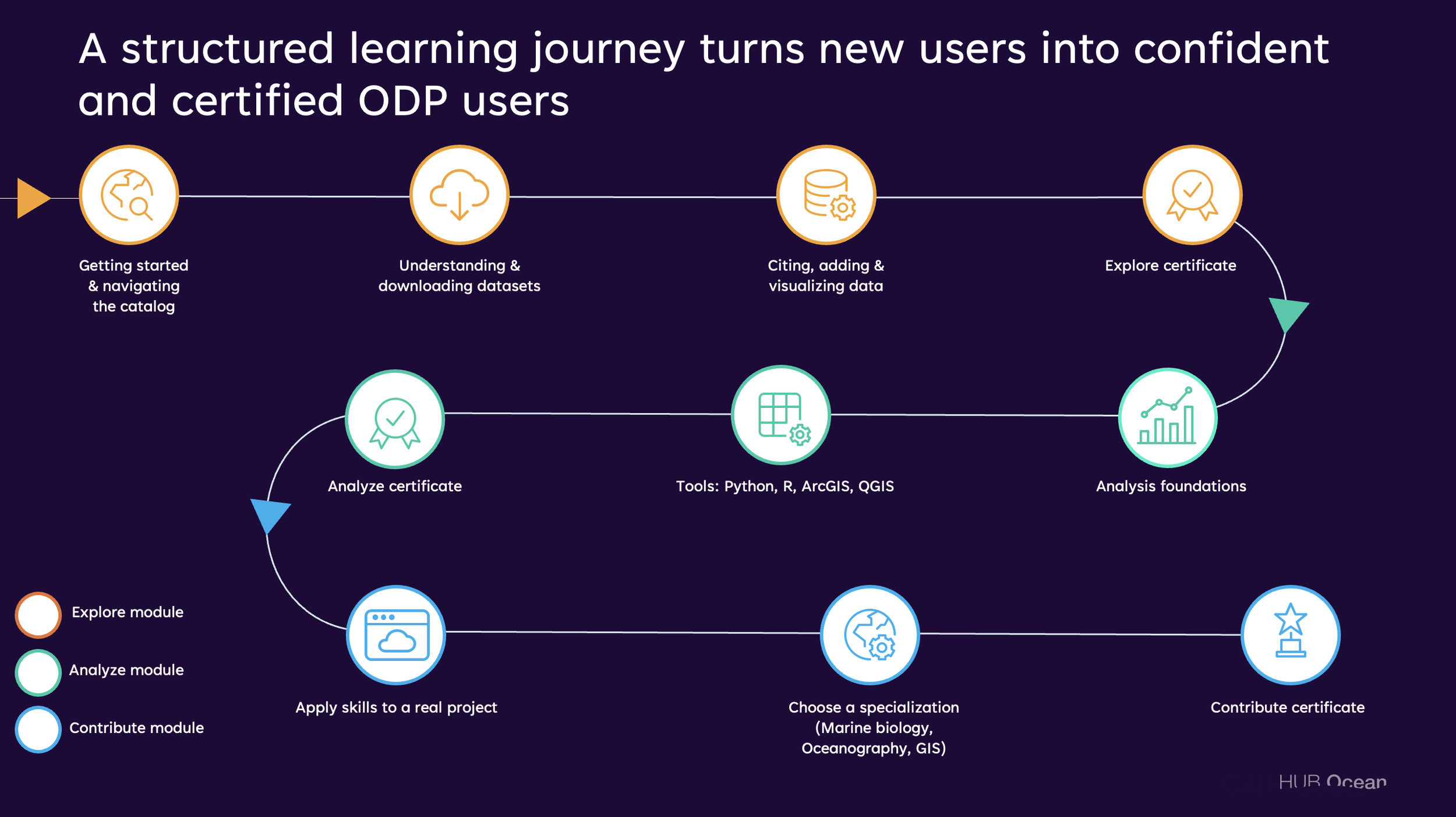
ODP Academy brings together three connected modules: Explore, Analyse and Contribute. Each builds on the last to guide you through an integrated learning journey.
-
Get to know the Ocean Data Platform and the data it holds. In this module, you learn to find ocean data, understand it and use it responsibly. You will learn how to:
Navigate the Ocean Data Platform
Discover datasets relevant to your questions
Understand dataset pages and metadata
Download and export data
Use real ocean datasets in your own work
Apply responsible data practices: citation and licensing
-
Move from finding data to working with it. In this module, you learn to analyse real ocean datasets from the Ocean Data Platform using the tool that fits your work: Python, R, QGIS or ArcGIS.
The module starts with the basics every track needs: how discovery leads to analysis, and the data formats you will work with (CSV, GeoJSON and Parquet).
Each track includes hands-on exercises built around real ocean questions. -
Put your skills to work on a project of your own. In this module, you choose a real ocean question, find the data on Ocean Data Platform, analyse it and present your results. You can also publish your work on the ODP so others can build on it.
Pick the track that matches your field or the data that interests you most:
Marine Biology: for ecology, conservation and biodiversity. Work with species occurrence records, survey data, plankton time series or coral reef health. You'll map where species are, count them and track change over time.
Oceanography: for physical and chemical oceanography, and climate science. Work with sea surface temperature, CTD depth profiles, currents or ocean chemistry. You'll spot trends, track anomalies and identify water masses.
GIS / Spatial Analysis: for geography, marine spatial planning and spatial conservation. Work with vessel traffic, protected area boundaries, bathymetry or habitat maps. You'll overlay layers, build density maps and track change over time.
ODP Academy also designs training for specific regions, sectors and professional groups. Together with SeaSketch and UFSC, we delivered a joint training on Marine Spatial Planning with Ocean Data for professionals in South America.
ODP Academy for Professionals
Explore South America's Ocean Data
The region's coastal and marine areas are among the most biodiverse in the world.
What Students Say
“The most valuable thing I learned during this course was how to find and use relevant data sets, as well as using AI tools to search for and understand the data”
“I learned how to handle and extract information and modify datasets. Learn how to create your own datasets and add them to the map. It was good”
“It was useful to try finding, filtering and working with ocean datasets on the ODP, and to learn how to assess whether a dataset is relevant to a research question”
Not sure where to start?
Whether you're an educator, student or
part of an organization, we're happy to help.
Ask us about course content, learning tracks, certificates or how to bring ODP Academy to your team.
Real data. Real skills.
Certified by

FAQ
-
Modules 1, Explore, and 2, Analyse, are free for universities to include in their curricula. Module 3, Contribute, is usually customised to fit the programme and requires funding.
Bespoke courses and tailored training may also be available through funded projects. Businesses can access ODP Academy through a partnership with HUB Ocean.
Contact us to find the right option for you. -
Yes. Students can create a free ODP account to setup a workspace and work with data during the course. Sign up here.
-
No. Some coding experience can be helpful for certain projects, but it isn’t required. Module 1, Explore, involves no coding. In Module 2, Analyse, students can use Python or R, or choose QGIS or ArcGIS for a visual, map-based approach.
-
Yes. Each public dataset on ODP has its own licence, and most can be reused with proper citation. The course shows students how to check a dataset’s licence and cite it correctly. They can also upload their own data to ODP and collaborate with others on it in the platform.
-
Yes. ODP Academy is available to universities on request. We help you choose datasets and exercises that fit your curriculum. Get in touch.
-
ODP Academy is offered through universities rather than as an individual course. If you’re interested, tell your professor or course lead and encourage them to contact HUB Ocean. You can also register your interest using the ODP Academy contact form. If we hear from enough students at your university, we may reach out to a professor there.