
HUB Ocean and Ecowende unlock first offshore wind farm data to accelerate knowledge sharing on North Sea ecology
NORTH SEA, THE NETHERLANDS – 10 September 2026 – Ecowende is making the first ecological data from its Hollandse Kust West offshore wind farm publicly accessible, giving researchers, offshore wind developers and other expert users new insight into the marine environment in and around the wind farm. The data is being shared through HUB Ocean’s Ocean Data Platform as part of the organisations’ joint commitment to make ecological data from offshore wind more accessible and reusable.
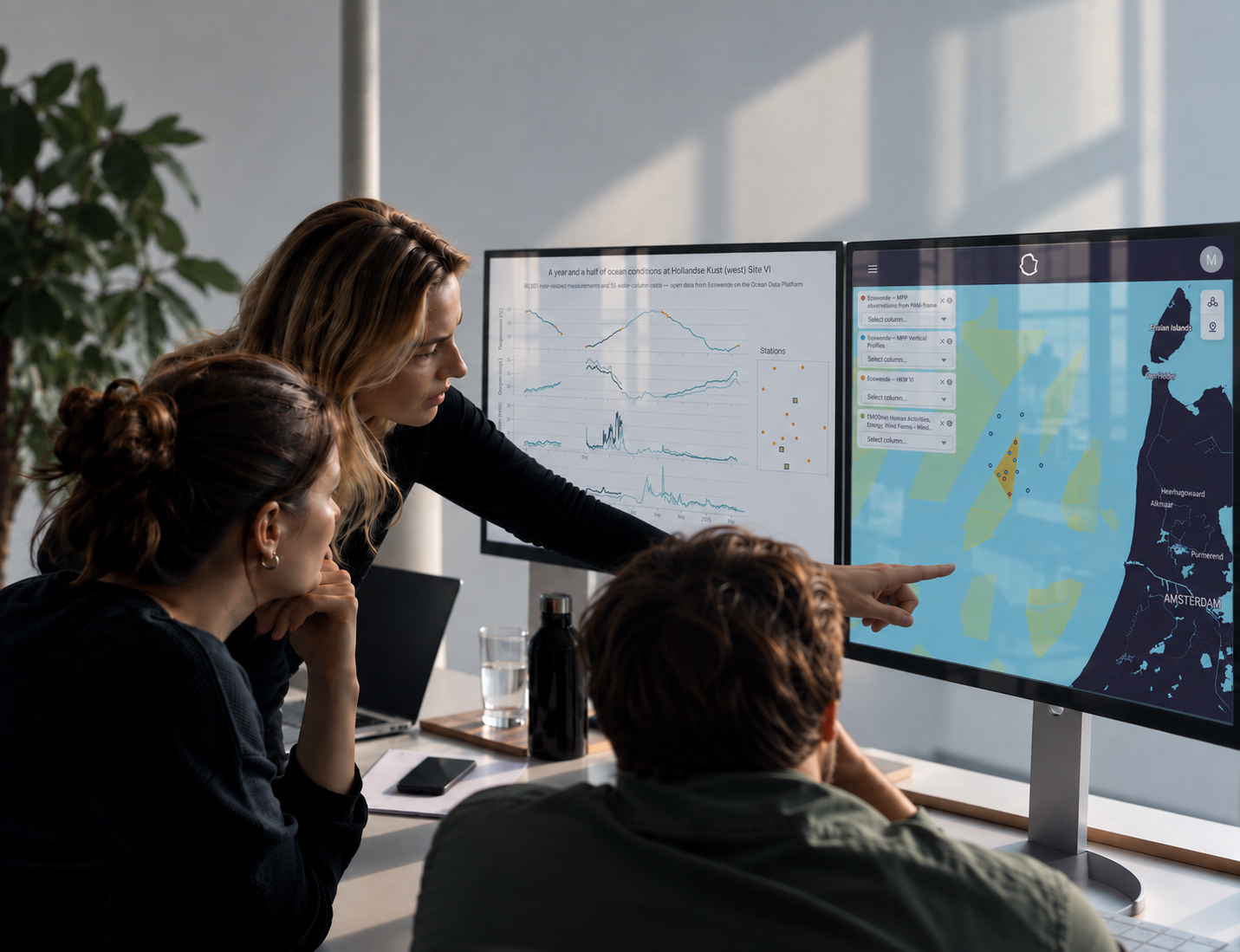
The first datasets include measurements from the multi-parameter probes (MPPs) installed on the Passive Acoustic Monitoring (PAM) frames in the wind farm, and vertical profiles with the same MPPs taken during the different visits to the wind farm since the start of monitoring. The data provides insight into underwater abiotic conditions.
A continuous picture of the marine environment
Ecowende’s PAM frames are equipped with multiple sensors and have been collecting continuous measurements close to the seabed since August 2024. The frames monitor harbour porpoise presence and underwater acoustic conditions.
Two of the frames are additionally equipped with an MPP. Located in the north and south of the wind farm, the two stations help Ecowende validate the spatial variability in environmental conditions. The MPPs continuously measure oxygen, chlorophyll, pH, water temperature, turbidity and salinity close the seabed.
Additionally, the vertical profiles provide a snapshot through the entire water column at different locations in the wind farm, where the probe is lowered from the surface to the seabed and back.

Laurence Janssens, COO, HUB Ocean
Together, the monitoring systems provide complementary information about the marine environment, combining continuous local measurements with vertical profiles through the full water column.
From data collection to shared knowledge
For Ecowende, making these data publicly accessible is an important part of its approach to nature-inclusive offshore wind. The project combines ecological innovations with extensive monitoring and research to fill knowledge gaps about the North Sea and improve understanding of how offshore wind and marine ecosystems interact.
“Collecting data is only the first step. The real value comes from turning data into knowledge and making that knowledge available to others,” says Hermione van Zutphen, Ecology Programme Manager at Ecowende. “We want researchers and other experts to be able to use our data, combine it with other datasets and potentially answer questions that we have not even considered ourselves. By sharing what we learn, we hope to contribute to a much broader knowledge base for offshore wind and North Sea ecology.”
The datasets are being made available through HUB Ocean’s Ocean Data Platform according to the scientific FAIR principles – Findable, Accessible, Interoperable and Reusable. This enables users to discover and reuse the data and combine it with other ocean datasets.
“Ocean data becomes more valuable when it is open, discoverable and connected to other sources. Ecowende is opening up data collected as part of an offshore wind project so that researchers and other experts can use it to explore new questions and build on each other’s work. By bringing these datasets onto the Ocean Data Platform, we are helping turn individual measurements into shared knowledge. That knowledge can support better decisions for both ocean health and the future development of offshore wind.” says Laurence Janssens, COO at HUB Ocean.

Hermione van Zupthen, Ecology Project Manager at Ecowende
Building knowledge for future offshore wind farms
The publication of the first datasets is only the beginning. As Ecowende’s monitoring and research programme progresses, additional datasets covering different species, ecological processes and environmental parameters will be added.
Ecowende believes that the transition to renewable energy and the recovery of marine ecosystems need to progress together. Closing knowledge gaps and sharing what is learned can help improve how future offshore wind farms are designed, built and operated.
“We cannot expect one project to have all the answers,” says Hermione van Zutphen. “But we can make sure that the data we collect also becomes available to others. The more data and knowledge we share across projects, organisations and disciplines, the faster we can improve our understanding of how offshore wind can work in harmony with nature.”
For more information, please reach out to:
Corine Steenwijk
Communications manager, Ecowende
Sive Einarsson
Communications Advisor, HUB Ocean
sive.einarsson@oceandata.earth
About Ecowende
A sustainable future for offshore wind that positively contributes to the North Sea’s ecology. An ambition that Ecowende hopes to bring to life through collaboration with partners, research, and progressive innovations. The Ecowende wind farm (Hollandse Kust (west) lot VI) will be located about 53 kilometres off the Dutch coast, near IJmuiden. The wind farm will have an operational capacity of approximately 760 MW, making 3% of the current Dutch electricity demand greener. Ecowende plans to have the wind farm fully operational and commissioned in 2026. For more information about Ecowende, visit www.ecowende.nl